We talk a lot about financial capital. We talk about skills. We talk about performance and productivity. We talk about the next role, the next opportunity, the next step.
But we rarely talk about the one thing that shapes our choices, our transitions, our confidence, and our future more than anything else: Identity Capital, as one of the most important forms of capital we rarely talk or think about, let alone invest in.
What identity capital actually is
Identity Capital is the collection of experiences, transitions, capabilities, values, and meaning structures that shape who we are becoming, not just what we do.
It’s built from the risks we took, the identities we let go, the countries we moved to, the failures that changed us, the difficult choices we made, the transitions we survived, the relationships that shaped our worldview, the stories we tell about our journey, and so on.
Identity Capital is not a personality trait. It’s not a resume. It’s not a list of skills. It is the architecture of our becoming. And the more nonlinear our journey is, the more Identity Capital we carry, even if it doesn’t always feel like it.
Why identity capital matters now (more than ever)
We are entering an era defined by AI reshaping the meaning of work, nonlinear careers, global mobility, role transitions, uncertainty as the baseline, hybrid identities, and continuous reinvention.
In this world, traditional stability is fading. What remains is our capacity to adapt, reimagine, integrate, evolve, and stay grounded in flux. This capacity comes from our Identity Capital.
It becomes our anchor, our differentiator, our inner resilience, our compass when the map disappears. Skills will matter, and tools will matter, but without Identity Capital, both collapse under uncertainty.
My own journey with identity capital
When I moved to the Netherlands, I didn’t just change countries. I stepped into a new version of myself. Everything familiar disappeared: language, networks, professional identity, relevance, relationships, and the feeling of “belonging.” Suddenly, I was navigating a landscape where my past experience didn’t automatically transfer. And in that uncertainty, I learned the deepest lesson: identity is not something we carry with us. It’s something we continuously rebuild.
Bennu Community itself grew out of this realization, and my journey over the past two years ended up in The Futures Hub and its ecosystem. It became a place for nonlinear journeys, transitions, identity reconstruction, capability-building, narrative coherence, and finding meaning in change.
Identity Capital for me isn’t theory. It has been lived experience you can see it now withing the TFH ecosystem.
What I see every day at The Futures Hub
Inside TFH, across Flux Forward, and Bennu Community, I meet people who are not just searching for opportunities or skills. They are searching for coherence, meaning, belonging, capability, confidence, and a new narrative for who they’re becoming.
I'm talking about engineers transitioning into strategy, researchers moving into industry, internationals building a new life in Europe, leaders reshaping organizations into adaptive systems, and founders navigating reinvention.
Underneath all of it? Yes, it's all about Identity Capital. It’s the invisible foundation that allows transformation to actually happen.
Identity Capital is a capability, not a trait
One of the biggest misunderstandings is believing identity is fixed. It’s not. Identity Capital grows through intentional reflection, reframing our story, building new capabilities, expanding our relational circles, stepping into uncertainty, embracing nonlinear journeys, and allowing transitions to transform us. It’s something we can cultivate, purposefully and consciously.
Think of it like a muscle: the more transitions we process, the more meaning we extract, the more coherent our narrative becomes, the stronger our Identity Capital becomes.
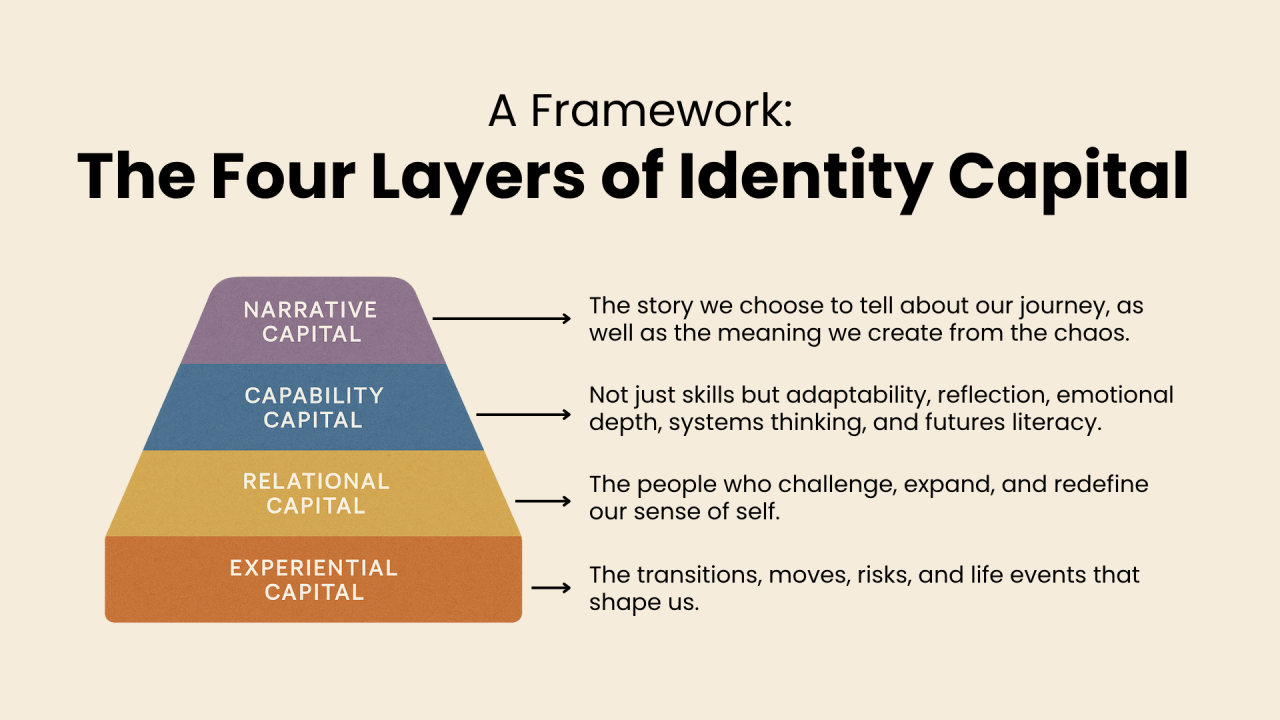
A framework: The four layers of identity capital
Here’s a simple lens I’ve developed through my work:
- Experiential Capital The transitions, moves, risks, and life events that shape us.
- Relational Capital The people who challenge, expand, and redefine our sense of self.
- Capability Capital Not just skills but adaptability, reflection, emotional depth, systems thinking, and futures literacy.
- Narrative Capital The story we choose to tell about our journey, as well as the meaning we create from the chaos.
Most people focus only on layer 3, not as capability, but just as a skill set, which is important but not enough in this ever-changing world. But true transformation requires all four.
The Future of Work Will Belong to Those Who Invest in Identity Capital
The bad news is: AI will automate tasks. Markets will shift. Roles will evolve. Industries will reshape. And the good news is: AI will automate tasks. Markets will shift. Roles will evolve. Industries will reshape. :)
Meaning: what remains, what cannot be automated, outsourced, or replaced, is our identity, our meaning, our adaptability, our self-understanding, our narrative intelligence, and our ability to navigate transitions.
Identity Capital becomes our inner technology, lifelong asset, and bridge into future possibilities. In a world of uncertainty, our identity is our infrastructure.
An invitation to reflect
If you’re reading this, I want to ask you a simple question:
What part of your Identity Capital are you building right now? Is it a transition, a new capability, a new story about who you are, a deeper understanding of your values, a community that expands your identity, or the courage to let go of an old version of yourself?
Identity is not what we carry from the past. Identity is what we choose to build for the future. And maybe, this is the most important work we can do in a world shaped by AI, uncertainty, and nonlinear journeys.